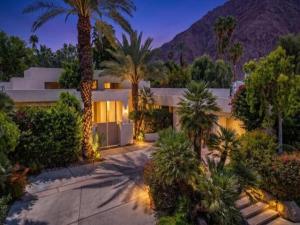
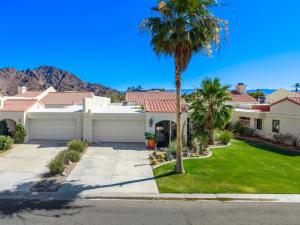
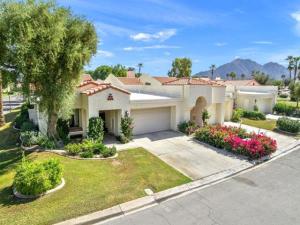
La Quinta Resort homes for sale sit alongside the La Quinta Resort and Club, established in 1926 and one of the Southwest’s oldest resort destinations. The community covers the residential properties adjacent to the resort, in a Coachella Valley city of roughly 43,000 residents backed by the Santa Rosa Mountains. Between the resort’s century-long history and PGA WEST’s golf courses nearby, this pocket of La Quinta draws buyers from well outside the valley.
The housing here is casitas and villas — resort-adjacent properties with access to the resort’s amenities rather than standalone estates on large lots. Prices run from about $500,000 to $2 million, and where a given home falls in that range comes down to property type, size, and how close it sits to specific resort amenities.
The decision most buyers face here is property type before location. Casitas tend to be the smaller, simpler option and sit at the lower end of the range, while villas offer more square footage and often a stronger rental profile. Because these are attached or clustered properties rather than estates on acreage, you are buying into a shared setting — walk the specific block, not just the listing. Distance to the amenities you actually plan to use matters more than a general sense of being close to the resort.
La Quinta Resort real estate also comes with association structures that vary from one pocket to the next, so ask early about dues, what they cover, and any restrictions on short-term rentals. Buyers arriving from outside the Coachella Valley should weigh seasonal use honestly: a property that works well for winter months carries the same carrying costs year-round.
Browse all Palm Springs & Riverside County real estate.
La Quinta Resort represents La Quinta’s residential golf community culture — the city’s identity is built around PGA WEST, whose multiple golf courses (including the Stadium Course designed by Pete Dye that has hosted the Bob Hope Classic and other PGA Tour events) have made La Quinta one of the world’s most recognized golf destinations. The various courses at PGA WEST — the Stadium Course, the Mountain Course, and the Norman, Nicklaus, and Weiskopf courses — create the residential community naming structure that La Quinta Resort fits within as part of La Quinta’s broader golf community ecosystem.
La Quinta Resort residential community encompasses the residential properties adjacent to the historic La Quinta Resort and Club — established in 1926, one of the Southwest’s oldest and most storied resort destinations — where casitas and villas provide the resort-adjacent residential option with the resort’s amenities accessible. The La Quinta Resort, established in 1926 and continuously operating as one of the Southwest’s premier resort destinations, anchors the community’s hospitality identity and sustains the name recognition that La Quinta enjoys globally among golf and resort travelers who have never visited the community as potential residents. The resort’s tennis academy, spa, and multiple pools create an amenity environment that residents of adjacent communities can access as members, enhancing the lifestyle infrastructure available to La Quinta homeowners beyond what purely residential communities can sustain.
La Quinta’s school district — Desert Sands Unified School District — serves the community for K-12 public education. The district’s performance is above average for the Coachella Valley, reflecting the professional demographic that La Quinta’s residential pricing attracts. La Quinta High School is a comprehensive campus with strong athletic programs (reflecting the community’s outdoor sports culture) and above-average academic performance within the desert district context. The specific school assignment for any address should be verified with Desert Sands Unified.
The I-10 Freeway is accessible from La Quinta via Highway 111 through Palm Desert and Indio, providing freeway access to the Los Angeles basin and points east. La Quinta’s position at the valley’s southeastern end means the I-10 connection is slightly longer from the community center than from Palm Springs or Palm Desert, but the practical difference is minimal — approximately 20 to 25 minutes from central La Quinta to the I-10 on-ramp. The Palm Springs International Airport is approximately 25 to 30 minutes from La Quinta by car.
The La Quinta Resort and Club — founded in 1926 and the oldest resort in the Coachella Valley — provides a luxury hospitality anchor whose proximity creates a distinct residential lifestyle for properties in the surrounding area. The resort’s 41 swimming pools, 23 tennis courts, five Pete Dye-designed golf courses, the Spa La Quinta, and the collection of dining venues create an amenity density that resort guests pay premium nightly rates to access; La Quinta Resort-adjacent residential properties benefit from the resort’s landscape quality, commercial vitality, and community activity without requiring resort room rates. The resort’s iconic Spanish hacienda architecture — white stucco, red tile roofs, and the casita-style accommodations clustered around courtyards and fountains — creates an aesthetic that has shaped the character of the surrounding residential development and is reflected in La Quinta’s Old Town architectural standards.
Residential properties marketed as “resort-adjacent” or “resort-area” in La Quinta vary in their actual proximity and access to the resort’s facilities — buyers should clarify whether any specific property includes resort amenity access (some residential developments have resort membership agreements), or whether the benefit is simply lifestyle proximity (walkability to Old Town, the resort’s commercial district, and the visual character of the resort environment). The La Quinta area’s concentration of independent restaurants along Old Town’s Calle Estado, the arts festival venue, and the Saturday farmers market create the year-round community commercial activity that supports the resort-adjacent lifestyle for full-time residents who want daily-life amenity beyond the resort itself. For buyers who want the La Quinta lifestyle without the golf club membership commitment, resort-adjacent residential properties provide the valley’s most complete non-club luxury residential experience.
Palm Springs International Airport provides direct service to Los Angeles (35 minutes), San Francisco (90 minutes), and major destinations across the United States and seasonal service to Canadian cities — the flight access that makes the Coachella Valley practical as a primary or secondary residence for buyers whose work and social connections are distributed nationally. The I-10 Freeway connects the valley to the Los Angeles basin (approximately 110 miles west) and to Phoenix (approximately 260 miles east), providing ground transportation access for buyers who prefer driving to flying for the LA-Palm Springs commute. Many LA-area professionals keep Coachella Valley homes as weekend destinations, making the 2-hour drive a routine element of their weekly lifestyle rather than an occasional trip.
The Agua Caliente Band of Cahuilla Indians’ sovereign land within the Coachella Valley — including significant portions of Palm Springs and the surrounding area — creates a unique land tenure situation that affects some residential properties. Homes built on Agua Caliente lease land operate under long-term ground leases rather than fee-simple ownership; buyers of such properties need to understand the lease term, renewal terms, and the implications for financing, resale value, and estate planning. Most lenders and buyers treat long-term lease land properties identically to fee-simple for practical purposes, but the distinction is important to research for any specific property under consideration.
The Coachella Valley’s summer heat — temperatures routinely exceeding 110 degrees Fahrenheit from June through August — is the primary lifestyle trade-off that the valley’s exceptional winter climate requires. Summer heat has historically emptied the valley as seasonal residents depart for cooler climates; the community facilities, restaurants, and cultural life that sustain the winter experience are often reduced during the summer months. Year-round residents adapt through pool lifestyle, early-morning outdoor activity before heat becomes prohibitive, and air-conditioned interiors that the architecture consistently accommodates. The Coachella music festival and the BNP Paribas Open tennis tournament at Indian Wells punctuate the spring calendar as major events that sustain the valley’s national profile.
The Coachella Valley is one of Southern California’s premier luxury resort and residential destinations — a desert basin rimmed by the San Jacinto, Santa Rosa, and Little San Bernardino Mountains where Palm Springs, Palm Desert, Indian Wells, La Quinta, and Rancho Mirage form a 30-mile corridor of golf courses, resort hotels, spa retreats, and luxury residential communities that attract buyers from across California, the United States, and internationally. The valley’s winter climate — sunny days in the 70s and 80s from October through April — drives a significant second-home and seasonal-residence market alongside the full-time residential population that has grown substantially as remote work has made year-round desert living increasingly practical for the professional demographic that once made the valley only a weekend or seasonal destination.
The Coachella Valley’s luxury residential market is golf-community-centric — the valley contains more golf courses per capita than virtually any comparable area in the United States, and the most prestigious communities are organized around championship golf courses designed by Jack Nicklaus, Pete Dye, Arnold Palmer, Tom Weiskopf, and other legendary course architects whose names on a community’s gates signal both the golf quality and the residential price tier. Guard-gated golf communities in Indian Wells, La Quinta, Rancho Mirage, and Bermuda Dunes provide the amenity package — golf membership, swimming, tennis, dining, social calendar — that the luxury second-home buyer demographic expects when they purchase in the desert at the price points that the valley’s premier communities command.
The 2026 residential pricing across the Coachella Valley spans from approximately $400,000 for standard condominiums in the valley’s more accessible communities to $5 million or beyond for the most exclusive estate properties in Indian Wells Country Club, Vintage Club, Quarry Golf Club, and other guard-gated trophy communities. The valley’s seasonal demand cycle — peak buyer activity from January through April during the winter residential season — creates price dynamics that differ from year-round residential markets; off-season (June through September) opportunities can exist for buyers willing to purchase during the extreme summer heat when touring activity declines significantly.
The Coachella Valley luxury real estate market operates on a seasonal rhythm unlike any California coastal market — the October through May “season” drives the majority of sales activity, as part-time residents arrive from the Pacific Northwest, Canada, the Midwest, and the Northeast to escape colder climates. This seasonal concentration means that the most competitive inventory windows are November through March, when buyer demand peaks alongside the BNP Paribas Open tennis tournament (Indian Wells, March), the golf tournament season, and the Coachella and Stagecoach music festivals (Indio, April). Off-season buyers (June through September) encounter less competition and more negotiating leverage but also reduced inventory, as sellers who can wait typically list during the high-visibility season months. Understanding this seasonal dynamic is essential for buyers and sellers navigating the CV market — the same property listed in February versus August will encounter fundamentally different buyer pools and pricing dynamics.
The Coachella Valley’s golf community market — the private club communities of Indian Wells, La Quinta, Rancho Mirage, and Palm Desert — has historically held value through economic cycles better than the Valley’s broader residential market. The supply constraint of limited equity memberships in the most exclusive clubs (The Quarry, Vintage Club, The Hideaway, Stone Eagle) creates a pricing floor that functions independently of broader market dynamics; when a club has a multi-year membership waitlist, the associated residential properties trade in a micro-market defined by club desirability rather than general real estate cycle. Buyers targeting specific club communities should understand both the club’s financial health and membership demand — factors that directly affect residential property values in ways that have no equivalent in non-club residential markets.
The desert luxury market’s long-term value drivers include the permanent seasonal demand from cold-climate snowbirds (a demographic that grows as Baby Boomer and Gen X wealth matures into retirement lifestyle spending), the increasing year-round viability created by modern air conditioning that has made desert summer residence comfortable for a growing segment of full-time residents, and the ongoing infrastructure investment (the Acrisure Arena, expanded Palm Springs International Airport service, and the Coachella Valley’s growing tech and entertainment industry presence) that is broadening the valley’s economic base beyond the traditional tourism and retirement economy. For buyers who approach the CV as a long-hold asset — a second home that will eventually become a primary residence as work-from-anywhere flexibility increases — the combination of lifestyle quality, supply-constrained club inventory, and growing year-round demand creates a fundamentally different risk profile than speculative purchasing based on short-term price movement.
La Quinta Resort area properties range from approximately $500,000 to $2 million depending on property type, size, and proximity to specific resort amenities. La Quinta’s overall market spans from approximately $500,000 for condominiums and smaller homes in the valley’s more accessible sections to $5 million or beyond for the Quarry’s mountain estate properties and other premium gated communities. Current pricing data for La Quinta Resort is available from The Knight Group.
La Quinta’s PGA WEST complex provides some of the Coachella Valley’s most celebrated golf, including the Stadium Course (public access via resort guest play, private club memberships also available), the Mountain Course, and the Norman, Nicklaus, and Weiskopf courses within the PGA WEST private club structure. The specific golf access available to residents of La Quinta Resort depends on the community’s membership structure; some PGA WEST communities include golf membership, while others require separate club membership purchase. La Quinta Country Club provides an alternative private golf option for residents who prefer its course to the PGA WEST options.
La Quinta has seen significant growth in year-round residents, driven by the remote work migration that the COVID-19 pandemic accelerated and the city’s investment in year-round amenities. The summer heat — temperatures regularly exceeding 115 degrees Fahrenheit — requires air-conditioned indoor life from approximately 10 AM to 6 PM from June through September, but the abundant pools, indoor fitness facilities, and early-morning outdoor activity window allow year-round residents to maintain active lifestyles. Many La Quinta full-time residents describe the summer months as a quieter, more affordable time when the seasonal crowd has departed and the community’s restaurants and facilities are less congested.
Access to La Quinta Resort amenities for non-guests depends on the specific residential community’s agreements with the resort. Some La Quinta residential developments include resort membership or day-use agreements; most do not, and residents access resort amenities as paying guests rather than as membership right. The resort’s spa, golf courses, and dining are open to non-guests with advance reservation and payment of applicable fees. The practical benefit of resort proximity for most residential owners is the lifestyle character of the neighborhood — the landscaped resort campus, the Old Town walkability, and the dining and commercial activity that the resort sustains — rather than complimentary access to resort facilities. Buyers who specifically want resort amenity inclusion should confirm any amenity access agreements for their specific property before purchasing based on that expectation.
Explore more La Quinta neighborhoods:
Signup for email alerts when properties match your interest!
Lucky for you we’re looking out.
Subscribe to this Custom Search to be alerted when new properties hit the market in the area.
Choose the frequency that works for you.