Browse all Los Angeles real estate — or explore the full Los Angeles luxury real estate market.
No properties found. |
Los Angeles luxury condos are attached, individually owned residences in professionally managed buildings, concentrated in a handful of Westside and central corridors: the Wilshire Corridor, Century City, Beverly Hills, West Hollywood, Bel Air, and Downtown. Ownership is governed by the California Davis-Stirling Common Interest Development Act, which means you own your unit and a share of the common areas, and a homeowners association controls the building envelope, the amenities, and the money that maintains both.
The value proposition is specific. You are buying staffed security, valet or attended parking, and a building that keeps running whether or not you are in town. For buyers splitting time between Los Angeles and another city, that lock-and-leave structure is the point. The trade-off is equally specific: you inherit a governing document, a monthly dues obligation, a reserve fund you did not build, and neighbors who vote on your building’s capital spending.
Browse the current inventory below, or contact The Knight Group to talk through which buildings actually match how you plan to use the property. The right question is rarely which unit. It is almost always which building.
Six areas carry most of the trophy condo stock, and they do not behave alike.
The Wilshire Corridor is the densest concentration. More than 30 high-rise residential buildings line Wilshire Boulevard between Beverly Hills and Westwood, a stretch marketed for decades as the Millionaire Mile. Stock ranges from 1960s and 1970s towers converted to condominium ownership through to full-service modern properties with concierge, valet, pools, and screening rooms. Floor plans skew large.
Century City is the corporate-adjacent tier. Century Park East, a pair of 19-story towers at 2160 and 2170 Century Park East completed in 1966, represents the older amenity stock. At the other end, the Fairmont Century Plaza Residences at 2025 Avenue of the Stars added 63 branded residences in the redevelopment of the original Century Plaza Hotel, a Minoru Yamasaki design. Note that not every marquee Century City address is for sale: Ten Thousand at 10000 Santa Monica Boulevard is a lease building, not a condominium.
West Hollywood is its own incorporated city, which matters more than most buyers realize at sale time. Sierra Towers at 9255 Doheny Road is the reference point: built in 1965 to a Jack Charney design, 32 stories, 146 units, converted to condominiums in 1974. It sits between Beverly Hills and the Sunset Strip and has traded on that position for fifty years.
Beverly Hills is also a separate city with its own building department, school district, and transfer tax regime. Its condo stock is lower-rise than the Wilshire Corridor and more tightly held. Bel Air carries very little condominium inventory relative to its name recognition, and most of what surfaces under a Bel Air search sits on the Wilshire Corridor edge or in adjacent Westwood. Downtown is the value tier per square foot and the most amenity-dense per dollar, covered in depth below.
Condos are moving slower than houses. Greater Los Angeles REALTORS reported that in April 2026 condominiums sold at a median price of $699,000 across 948 closed sales, against 5,950 active condo listings and a median 26 days on market. Single-family homes in the same report posted a $1,037,410 median across 3,008 sales, with 12,519 listings and a median 14 days on market.
Read those two lines together. Houses cleared in roughly half the time condos did, on a listing pool only about twice as large. That is the condo segment absorbing more slowly, which is what you would expect where carrying costs, dues, and insurance are all under pressure. GLAR President Chris Duff described the environment as normalizing, with buyers more selective and pricing heavily influenced by affordability and rate pressure.
Those medians cover all of Greater Los Angeles and include large volumes of entry-level product, so they are not the luxury tier. What they tell you is the direction of the current: condo buyers in 2026 have time and leverage they did not have three years ago. In the trophy tier that shows up as longer marketing periods and more negotiation on terms, not as broad discounting in the best-run buildings.
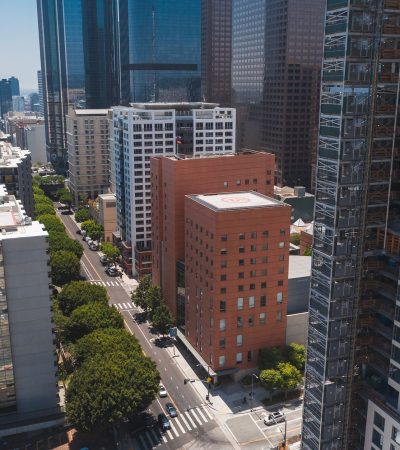
Downtown is the submarket with the deepest inventory and the widest price band, and it has its own dedicated page. Start with Downtown luxury condos, which covers the South Park and Financial District high-rises along with the converted-loft product in the Arts District and along Broadway.
Downtown’s anchor buildings are recognizable. The Ritz-Carlton Residences at 900 West Olympic Boulevard sit above LA Live, with hotel-side services attached and residences running from compact one-bedroom layouts up through very large full-floor plans. Metropolis opened its first residential tower in December 2016. Ten50 sits in South Park with skyline exposure. Alongside those, the Broadway and Industrial Street loft conversions are a different product entirely: large volumes, original industrial structure, and building rules unlike a full-service tower.
Downtown deserves its own review because price per square foot there has diverged from the Westside. Some of that gap is genuine opportunity. Some reflects real building-level problems. Sorting the two apart requires the association’s financials, not the marketing.
Dues are the second mortgage payment nobody underwrites. Industry sources covering the Wilshire Corridor put typical monthly dues there at roughly $1,400–$1,500, with staff-heavy buildings well above that. Treat any published figure as a starting point: dues vary by building, by unit size, and by how honestly the association funds its reserves.
In a full-service high-rise, dues typically fund staffing (front desk, valet, security, engineering), common-area utilities including elevator and common HVAC operation, professional management, the master insurance policy, and the reserve contribution for elevator modernization, roofing, plumbing risers, and similar capital items. The reserve line matters most and gets the least attention from buyers.
Insurance has been the fastest-moving cost input. HOA master policy premiums across California have risen sharply in recent years and associations have passed that through. When two comparable buildings differ by several hundred dollars a month in dues, the higher number is often the building actually funding what it owes rather than deferring it. Low dues are not automatically good news.
Yes, if the unit is inside the City of Los Angeles and the price crosses the threshold. Measure ULA applies to residential and commercial property in the City of Los Angeles, and condominiums are covered the same as single-family homes.
Per the City of Los Angeles Office of Finance, for transactions closing after June 30, 2026 the thresholds are $5,400,000 and $10,900,000. Sales above $5,400,000 and below $10,900,000 are assessed at 4%. Sales at or above $10,900,000 are assessed at 5.5%. The thresholds are adjusted annually for inflation. Two mechanics matter: the tax is calculated on the full gross sale price once a threshold is crossed, with no exclusion for the portion below it, and it sits on top of the existing City of Los Angeles and Los Angeles County documentary transfer taxes. The seller pays it at closing, on gross price, not on gain.
Geography changes the answer completely. Measure ULA reaches only the City of Los Angeles, so the county’s separately incorporated cities, including Beverly Hills and West Hollywood, are not covered. Century City, Bel Air, Westwood, and Downtown are inside the City of Los Angeles and are covered. Santa Monica sits under its own Measure GS, which applies a 5.71% rate on sales at or above $8 million, effective March 1, 2023.
The practical effect is a hard behavioral line just under $5.4 million. Sellers price to stay beneath it. Buyers negotiating in the $5.2 to $5.6 million band should understand that the seller’s math above the line is not linear, and that the same unit in West Hollywood or Beverly Hills carries a materially different exit cost than one in Century City.
Four documents decide whether a building is a good buy: the reserve study, two years of financials, the board minutes, and the litigation and assessment disclosures.
Pull out these items specifically. Reserve funding percentage and whether the association is on a funding plan or deferring. Any special assessment levied, pending, or discussed in minutes. Delinquency rate on member assessments. Open litigation, particularly construction defect, water intrusion, or habitability. The master policy carrier, limits, and per-unit deductible. Owner-occupancy versus rental concentration. And any leasing restriction, which for buyers planning to rent is often the deal-breaker nobody found until week three.
Minutes are the most useful and least read document in the package. Financials show you what happened. Minutes show you what the board is worried about and has not yet priced.
SB 326 added Civil Code section 5551 to the Davis-Stirling Act and requires condominium associations to inspect exterior elevated elements: balconies, decks, stairways, and walkways whose load-bearing components are supported substantially by wood or wood-based products, along with their associated waterproofing. Inspections must be performed by a licensed architect or a licensed civil or structural engineer, and they repeat on a nine-year cycle.
The initial statutory deadline was January 1, 2025. Any association that has not completed its inspection is now past that date. There is no agency actively auditing compliance and the statute does not set a monetary penalty, but the downstream consequences are real: noncompliant associations face insurance nonrenewal, lending and resale complications, and materially increased negligence exposure if something fails.
For a buyer the question is short. Has this association completed its SB 326 inspection, what did the report find, and is the remediation funded? If the answer is vague, that vagueness is itself information about how the building is run.
Not always, and this is where luxury condo deals fall apart most often. Fannie Mae runs a project-level review through Condo Project Manager, and loans on units in a project flagged “Unavailable” are ineligible for Fannie Mae purchase. Owners and buyers cannot query that database directly: it is lender-accessible, so confirming a building’s status requires a lender or mortgage broker.
The flags that push a project to “Unavailable” are consistent: critical repairs or significant deferred maintenance, litigation involving safety or habitability, special assessments tied to unresolved repairs, member assessment delinquencies above 15%, excessive rental concentration, inadequate reserves, and insurance gaps. Beginning July 1, 2026, the maximum allowable per-unit deductible on a master property insurance policy is capped at $50,000, which is going to surface as a new problem in buildings that raised deductibles to control premium.
A project that fails agency review is not necessarily unfinanceable. Portfolio lending, non-warrantable condo programs, and other non-agency options exist, generally at a larger down payment, a higher rate, or both. Establish which track you are on before escrow, not after. Ask the lender to run the project the same week you tour the unit.
Rail is arriving on the exact corridor where most of this inventory sits. Metro opened new D Line stations at Wilshire/La Brea, Wilshire/Fairfax, and Wilshire/La Cienega on May 8, 2026. The next phase, adding stations in Beverly Hills and Century City, is tentatively scheduled to open in spring 2027, followed by UCLA and the VA in a phase tentatively planned for fall 2027.
Be measured about what this does to values. Rail access is a real amenity for a Century City or Wilshire Corridor owner who works Downtown, and it strengthens the lock-and-leave case. It is not a guaranteed appreciation event, and construction along Wilshire has been a live nuisance on some blocks for years. The defensible claim is narrower: buildings within a short walk of a station gain a feature a competing tower a mile away cannot replicate. Weigh it as a feature, not a forecast.
At $3 million in Los Angeles you can buy a large full-service condo on a high floor with valet, staff, and views, or you can buy a house with land and control. Those are different products serving different lives.
The condo case is strongest for buyers who travel, who are downsizing out of a large property, who want zero exterior maintenance, or who need a Los Angeles base that can sit idle for stretches without deteriorating.
The house case is strongest for buyers who want to renovate on their own timeline, who need real outdoor space, or who do not want their capital exposed to a board’s spending decisions. Add one liquidity consideration from the April 2026 data: single-family product in Greater Los Angeles is absorbing faster than condo product, which is worth pricing into a hold period.
Four profiles recur. Entertainment and finance professionals who want proximity to Century City or Downtown without a commute. Buyers exiting large Westside houses who want the address without the roof, the pool, and the gardener. Out-of-state and international buyers building a Los Angeles base. Investors treating the trophy tier as a store of value.
Each weights the checklist differently. The lock-and-leave buyer cares most about staffing and security. The downsizer cares most about floor plan and storage, where older towers frequently beat newer ones. The investor cares most about leasing rules and the exit tax position, where the City of Los Angeles boundary becomes a real number.
The seller pays it at closing. It is a transfer tax on the gross sale price, not a purchase-side tax and not a tax on gain. As a buyer, it matters because it shapes how sellers price near the thresholds and because it will apply to you on your own exit if the unit is in the City of Los Angeles.
No. Measure ULA applies within the City of Los Angeles. Beverly Hills and West Hollywood are separate incorporated cities and are not covered. Santa Monica has its own Measure GS, which applies at 5.71% on sales at or above $8 million.
It varies too widely to give a single number honestly. Industry sources covering the Wilshire Corridor cite typical dues in the neighborhood of $1,400–$1,500 per month, and buildings with deeper staffing and amenity programs run considerably higher. The more useful exercise is comparing dues against the reserve study rather than against another building.
It depends on the CC&Rs and any rental cap the association has adopted. Some buildings permit leasing subject to a minimum term. Some cap the percentage of units leased at one time. Short-term rental is separately regulated by the municipality. If rental income is part of your plan, confirm both layers in writing before you buy.
Almost always a project-level flag rather than anything about you. Fannie Mae’s Condo Project Manager can mark a project “Unavailable” for deferred maintenance, safety or habitability litigation, unresolved special assessments, assessment delinquency above 15%, rental concentration, thin reserves, or insurance gaps. Your lender can check the status, and non-agency or portfolio financing may still work at different terms.
You should be informed about them, not automatically worried. A building that levies an assessment to complete required work is often in better shape than one avoiding the same work. Read the reserve study and the minutes together. The dangerous pattern is a large known capital need, a thin reserve, and a board that has not scheduled a funding decision.
Civil Code section 5551 targets exterior elevated elements whose load-bearing components are supported substantially by wood or wood-based products. Buildings without those elements may fall outside the inspection requirement, but that call belongs to a licensed architect or engineer retained by the association. Ask for the association’s written determination rather than assuming.
On price per square foot, generally yes. Whether it is a better buy depends on the specific building. The Downtown gap reflects both genuine value and real building-level issues in some projects. Review the individual associations before treating the discount as free money, and start with our Downtown luxury condos page for the building-by-building picture.
We work building first, unit second. Before we tour, we establish which associations are financially sound, which are carrying unfunded capital needs, which have completed SB 326 inspections, and which are likely to clear agency project review. That research eliminates buildings early, which is faster and cheaper than discovering the problem in escrow.
On the sell side, we price against the Measure ULA thresholds deliberately rather than accidentally, and we prepare the HOA document package before listing so buyer questions do not stall the deal at day fourteen. On the buy side, we coordinate the lender’s project review in parallel with the inspection timeline so financing risk surfaces while contingencies are still live.
We do not tell clients every building is a good building. Several of the best-known towers here have real issues, and several less-marketed ones are run better than their reputations suggest. If you are weighing specific buildings on the Wilshire Corridor, in Century City, in West Hollywood, or Downtown, contact The Knight Group and we will give you the financial picture on each before you spend a Saturday touring.
The Knight Group is here to help you with all your realty needs. To get started, fill out the form below and one of our experienced agents will contact you as quickly as possible.
Copyright © 2024 The Knight Group.
All rights reserved. License: 02133297
Lucky for you we’re looking out.
Subscribe to this Custom Search to be alerted when new properties hit the market in the area.
Choose the frequency that works for you.