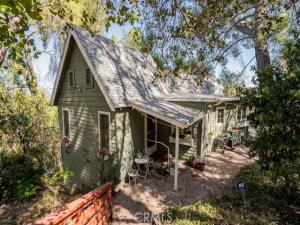
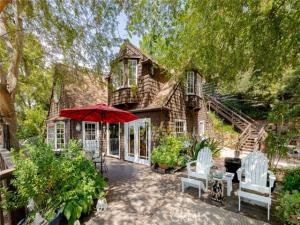
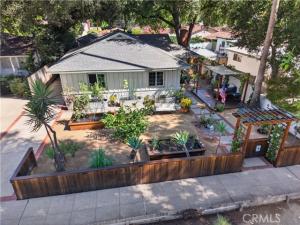
Girard Tract Woodland Hills Homes for Sale currently number 4 active listings with a median asking price of $1,037,000 (CRMLS, September 2026). Lots are the most compact of the 9 Woodland Hills sub-markets tracked, a median of 6,536 sq ft against 21,468 sq ft in Walnut Acres Estates.
Browse all Los Angeles real estate — or explore the full Los Angeles luxury real estate market.
Most homes in Girard Tract date to the 1950s and 1960s, with low-slung ranch profiles, wide street setbacks, and mature landscaping typical of postwar San Fernando Valley tracts. The 1989 specific plan ordinance set design and development standards for the neighborhood, which residents and local groups point to as a reason the tract has retained a consistent look even as many homes have been remodeled or expanded over the years.
A meaningful share of the homes back onto or sit within view of the Woodland Hills Country Club golf course, and that proximity is one of the defining features for buyers shopping this part of the neighborhood. Sale prices across Girard Tract have ranged from around $800,000 for smaller, unrenovated ranch homes to roughly $3,000,000 for larger or fully remodeled properties, with an average sale price around $1,200,000 (source: Redfin, local real estate listings).
Homes in this area of Woodland Hills offer a combination of architectural character, established landscaping, and strong community identity that attracts buyers looking for something beyond a generic suburban tract. While the broader Woodland Hills market provides a range of options, this particular pocket has its own micro-market dynamics — often with faster absorption times and tighter inventory than comparable addresses across town.
gated communities and newer planned developments carry HOA fees; older Ranch-style neighborhoods typically are non-HOA Buyers who prioritize privacy, outdoor space, and a neighbors-who-wave culture consistently point to neighborhoods like this one as undervalued relative to the broader San Fernando Valley market.
The homes in this area range from post-war single-family residences to updated modern builds, with many properties undergoing significant renovations over the past decade. Lot sizes are competitive for Los Angeles County standards. Most homes feature private outdoor space, attached garages, and mid-century design cues that have become increasingly sought-after in Southern California real estate.
Buyers with specific taste — whether for Spanish Colonial, Craftsman, or Contemporary — will find homes here that meet that brief. The range of price points within the community also means that entry-level buyers and move-up buyers often shop the same streets, which keeps demand diversified across market cycles.
This area of Woodland Hills has tracked alongside or above the broader San Fernando Valley appreciation curve over the past several years. Rental demand is also strong — single-family homes in Woodland Hills attract quality long-term tenants, making buy-and-hold strategies viable even with current interest rate environments. The Knight Group tracks off-market opportunities in this area specifically because they rarely generate open-offer situations and tend to close with less friction than listed properties.
The Girard Tract is Woodland Hills’ oldest planned residential development — the original estate-lot subdivision that the 1920s and 1930s developer Charles Girard created as the western SFV’s first upscale residential address. The neighborhood’s large lots (many ranging 15,000-30,000+ sq ft), the mature tree canopy (the original estate plantings that 90+ years of growth have produced), and the established neighborhood character of the curving residential streets create the most historically significant residential character in Woodland Hills. The 1920s-1930s period architecture that remains in the original Girard Tract homes — the Spanish colonial revivals, the English colonials, and the period Tudor designs that the earliest estate buyers commissioned — provides the architectural variety that no subsequent tract development phase has replicated in the Woodland Hills market. Many original Girard Tract structures have been replaced or substantially renovated over the decades, but the lot sizes, the street layout, and the mature tree canopy preserve the estate-lot character that the original Girard development established. For buyers who value the historical residential character and the estate lot sizes that the original Woodland Hills development created, the Girard Tract remains the most distinctive address in the Woodland Hills residential market.
Fire Risk: Girard Tract sits on the flatter portion of Woodland Hills north of the golf course, away from the Santa Monica Mountains foothills that carry the highest wildfire designations in the area.
Climate: As a flatland tract, Girard Tract experiences typical San Fernando Valley summer heat, with mature trees on many of the older lots providing more shade than newer, more sparsely landscaped streets nearby.
Getting Around: The neighborhood is positioned near Topanga Canyon Boulevard and Vanowen Street, giving residents direct routes toward Warner Center and the 101 freeway, while the golf course itself anchors the interior of the tract.
Schools:
Water: Water service is provided by the Los Angeles Department of Water and Power (LADWP).
Los Angeles Unified School District (LAUSD) serves this area. Within the neighborhood’s draw zone, families typically access Haynes Charter, Robert Frost Middle, and El Camino Real Charter. LAUSD and private school options are also available for families pursuing specialized programs in math, arts, or bilingual education. The availability of strong public schools at multiple grade levels is a consistent driver of demand in this area.
Residents commute primarily via Ventura Blvd, the 101 Freeway, and De Soto Ave, with typical drive times of 25–50 minutes to Warner Center, Burbank, and Century City. For buyers who prioritize non-freeway alternatives, local surface streets and rideshare coverage are solid. Remote work has reduced the commute calculus for many buyers in this market, but access to major employment corridors still factors into pricing at the neighborhood level.
Day-to-day conveniences are handled by The Village at Westfield Topanga, Ventura Blvd restaurant corridor, and Warner Center. Grocery options, pharmacies, fitness studios, and coffee shops are accessible without significant driving. The mix of national brands and local independents gives the area a lived-in feel that distinguishes it from purely commercial suburban centers.
Outdoor recreation centers on Topanga State Park, the Nash Bridges filming locations, and Westfield Topanga. Year-round outdoor activity is the norm in Southern California, and this neighborhood’s access to trails, parks, and recreational facilities is a meaningful part of the value proposition for active buyers. Nearby options expand the range further for buyers who prioritize specific activities like cycling, hiking, or swimming.
Girard Tract is tracked as a distinct sub-market of Woodland Hills, and its figures diverge from the parent average. The measurements below come from CRMLS listing data as of September 2026.
Median lot size separates Woodland Hills sub-markets more sharply than price does. Girard Tract ranks 9th of the 9 comparable sub-markets tracked here.
Girard Tract trades close to asking price. Across 10 recorded sales, homes traded at a median of 99.0% of their original asking price after a median 14 days on market (CRMLS, September 2026). Asking prices are what sellers hope for; these are the numbers they accepted.
Negotiating room is not evenly distributed across price. Measured across recorded sales in this dataset, the gap between asking and accepted widens sharply at the top of the market.
What is Girard Tract known for?
It is one of the largest neighborhoods in Woodland Hills, made up of roughly 1,515 mid-century homes wrapped around the Woodland Hills Country Club golf course, with a 1989 specific plan ordinance that has helped preserve its architectural character.
What style of homes are in Girard Tract?
The tract is largely made up of 1950s and 1960s ranch-style homes on wide lots, many of which have been remodeled or expanded while keeping their original low-slung profile.
What is the price range for homes in Girard Tract?
Recent sales have ranged from around $800,000 for smaller original homes to roughly $3,000,000 for larger or fully remodeled properties, with an average sale price near $1,200,000.
Competition varies significantly by price point and condition. Turnkey single-family homes in desirable pockets of Woodland Hills often attract multiple offers — particularly when listed under $900K. Fixer-uppers and properties with deferred maintenance see much softer competition. Working with an agent who has real-time visibility into days-on-market and offer-history data is critical to calibrating your bid strategy correctly.
Woodland Hills has demonstrated consistent appreciation over the past decade, supported by Woodland Hills offers more square footage per dollar than most Valley markets, attracting value-driven buyers. While no market guarantees future returns, the fundamentals here — limited land supply, strong school performance, and proximity to employment — align with the characteristics that historically underpin sustained appreciation in Southern California. The Knight Group can provide a detailed appreciation analysis for specific streets or sub-neighborhoods on request.
A meaningful percentage of transactions in Woodland Hills — particularly in the upper price tiers — never hit the MLS. Sellers who want privacy, convenience, or to avoid the preparation costs of a listed sale often prefer a direct buyer introduction. The Knight Group maintains an active off-market network in Woodland Hills and can present qualified buyers to sellers before a property is listed. If your target property type is not available on-market, a conversation with our team about off-market options is worth having.
Woodland Hills contains multiple distinct micro-neighborhoods, each with its own character, price range, and amenity profile. The differences between a north-of-Ventura address and a south-of-Ventura address in this area, for example, can be meaningful in terms of pricing, lot size, and school assignment. The Knight Group provides neighborhood-level guidance — not just city-level — to ensure buyers understand exactly what they are buying into before making an offer.
The Girard Tract’s original development included deed restrictions and covenants that have been modified or expired over the decades since the 1920s-1930s establishment period. Current property owners should research the current status of any remaining deed restrictions through a title search; the original era CC&Rs are largely not enforceable in their original form due to legal changes, but some architectural review processes and minimum lot size restrictions may persist in modified form. The City of LA’s zoning regulations now govern the primary land use and development standards for Girard Tract properties.
Explore more Woodland Hills neighborhoods:
Signup for email alerts when properties match your interest!
Lucky for you we’re looking out.
Subscribe to this Custom Search to be alerted when new properties hit the market in the area.
Choose the frequency that works for you.