Hollywood Hills Condos: What You Get for the Address
Hollywood Hills condos are attached homes built into the slopes of the Santa Monica Mountains between Hollywood and the San Fernando Valley, and they are the entry point to a hillside address. You get canyon quiet, city or valley views, and a location minutes from the studios at a fraction of the detached market. What you give up is control. The association owns the road, the roof, and the hillside behind the building, and it decides when repairs happen and what they cost.
Most inventory here was built between 1953 and 1982, so this is a market of named buildings rather than generic stock. Location does the rest: the Cahuenga Pass, the Hillside and Franklin corridor near Runyon Canyon, and the Sunset Strip flank each carry a different commute, noise profile, and resale pool.
Browse the listings below, or contact The Knight Group and we will pull the HOA financials, reserve study, and sales history on any building here before you spend a Saturday touring it.
Where exactly are the Hollywood Hills, and where do the condos sit?
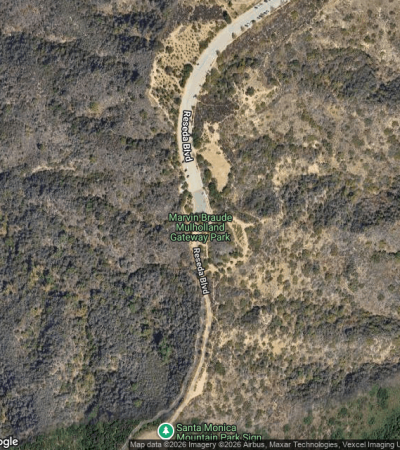
The Hollywood Hills run along the eastern Santa Monica Mountains, bounded by Mulholland Drive on the ridge and Hollywood and West Hollywood at the base. Hollywood Hills West is bisected by Laurel Canyon Boulevard, borders Outpost Drive on the east, ends at the Beverly Hills city line on the west, and stops at Mulholland Drive on the north. Hollywood Hills East runs from the Cahuenga Pass toward Griffith Park.
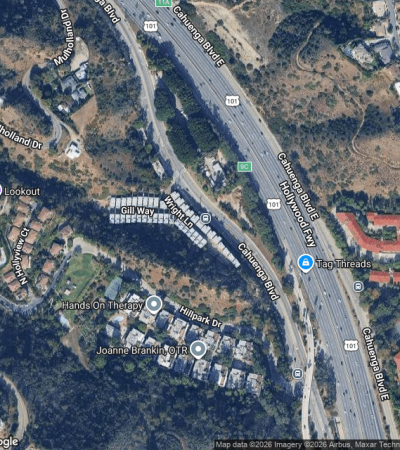
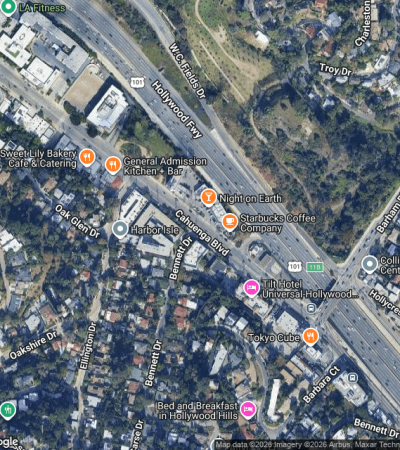
Condos cluster in three places: the Cahuenga Pass, the primary shortcut between the Los Angeles Basin and the San Fernando Valley, where the 101 carries the traffic and Cahuenga Boulevard carries the addresses; the Hillside and Franklin corridor above Hollywood near Runyon Canyon; and the Sunset Strip flank on the western side. Which one a building sits in tells you most of what you need to know about its commute, noise profile, and resale pool before you see a floor plan.
Which buildings and pockets make up this market?
This is a market of named buildings, not generic inventory. Units in one complex trade differently from units three hundred yards away, because the association, the vintage, and the view orientation differ.
In the Cahuenga Pass, the largest community is Cahuenga Hills Tennis Club at 2700 Cahuenga Boulevard East. Built in the mid 1970s, it spans four buildings and 174 units across roughly 33 acres per the association’s community page, with three tennis courts, two pools, a gym, a clubhouse, and trail access. Nearby, Pilgrimage House at 2260 North Cahuenga is a five story 1965 building with 40 units and, per building data compiled by Highrises, living areas from 853 to 1,768 square feet. Cahuenga 18 at 2111 North Cahuenga is the newest product on this page: 18 three story townhomes completed in 2018, roughly 1,461 to 1,735 square feet. 2775 Cahuenga sits between them on the same corridor.
Further north toward Universal City, the character shifts from Hollywood to studio adjacent. Toluca Hills at 3480 Barham Boulevard is a gated low rise built in 1981, with one and two bedroom layouts running roughly 800 to 1,350 square feet and keyed access to the Wisdom Tree and Lake Hollywood trails. Thirty Four Fifty West at 3450 Cahuenga Boulevard West is a 2008 development of 69 three story townhomes, several configured as live and work units, which is unusual inventory here and draws a specific buyer. On Fredonia Drive, Skyline is a small 1981 townhome community with units in the 1,429 to 1,594 square foot range, minutes from the studios and the Metro B Line.
The Hillpark pocket holds the most architecturally significant association in the group. The Highlands, at 6700 to 6760 Hillpark Drive, dates to 1966 and was designed by Paul R. Williams, the first Black architect admitted to the American Institute of Architects. It occupies roughly 14 acres just beyond the Hollywood Bowl and carries two pools, a spa, a fitness center, a dry sauna, two tennis courts, a community room, and a dog run. Amenity load that heavy is a benefit and a cost at once, and the dues reflect both.
On the Hollywood side, The Murray Hill at 1900 Vine Street is a four story, 54 unit building from 1980 in the Hollywood Dell, which puts residents inside the LAUSD Cheremoya, Le Conte, and Hollywood High attendance pattern. Highland Terraces at 1940 North Highland Avenue is an 82 unit 1982 building on the Highland corridor with direct access down to Hollywood Boulevard.
West of there, the Hillside Avenue cluster sits under Runyon Canyon. Key Largo at 7260 and 7270 Hillside Avenue is a 50 unit 1965 building, and Hillside West sits a few doors down at 7259 Hillside Avenue, effectively at the Runyon trailhead. On Franklin Avenue, The Continental at 7309 Franklin is a five story, 30 unit 1962 building known for unusually generous floor plans that newer buildings rarely match at the same price. Down the hill at 1615 North Laurel Avenue, Laurel Palms is a 36 unit 1953 building and the oldest association on this page.
Three entries here are areas rather than single buildings, and they behave differently. Sunset Strip is one of the largest sub areas of Hollywood Hills West and contains the Bird Streets and Doheny Estates enclaves, with Beverly Hills to its west and Laurel Canyon to its east. Hollywood Hills West is the wider district that also holds Laurel Canyon, Lookout Mountain, Mount Olympus, Sunset Plaza, Nichols Canyon, and Crescent Heights. Beachwood Canyon is the historic Hollywoodland tract, laid out from 1923 by a syndicate including Harry Chandler, Sidney Woodruff, and M. H. Sherman and marketed with a $21,000 sign reading Hollywoodland. The last four letters came down in 1949, which is why the Hollywood Sign exists. Attached inventory in these three areas is thinner and less standardized, so pricing follows the individual property more than the association. Mulholland Park sits in the ridge adjacent band near Mulholland Drive, where terrain is steeper and the view premium is highest. We do not publish unit counts or dues for that pocket because we have not verified them against association records. Ask, and we will pull the current documents.
What do Hollywood Hills condos cost?
Condos here trade well below the detached market they sit inside. Per Redfin, the median sale price across all Hollywood Hills home types over the twelve months ending in mid 2026 was $1,765,000, down about 4% from the prior twelve month period, while the three month window ending May 2026 showed a median of $1.7 million, up 4.5% year over year. Those figures are dominated by detached houses. Attached inventory sits materially lower, which is why this category exists at all.
Two things move a unit off any neighborhood median. The first is view orientation: a south facing unit with a basin view and a north facing unit in the same building are not the same asset, and the spread between them can exceed the spread between two different buildings. The second is dues and the reserve position behind them. Low dues in an association with a thin reserve price in a special assessment you have not been told about yet.
Timing has loosened. Redfin reported Hollywood Hills homes averaging 96 days on market in that same window, up from 56 a year earlier, with condos faster at roughly 41 days. That favors prepared buyers and punishes sellers who price to the peak rather than the current comparable set.
Why does the vintage of the building matter so much here?
Most Hollywood Hills condo stock was built between the early 1950s and the early 1980s: Laurel Palms in 1953, The Continental in 1962, Pilgrimage House and Key Largo in 1965, The Highlands in 1966, Cahuenga Hills Tennis Club in the mid 1970s, and Toluca Hills, Skyline, The Murray Hill, and Highland Terraces in the 1980 to 1982 window. Cahuenga 18 and Thirty Four Fifty West are the outliers.
A building of that age has consumed most of the useful life of its major components. Roofs, plumbing risers, elevators, electrical service, decks, and retaining walls sit on replacement clocks that started decades ago. That is not a reason to avoid the category. It is a reason to buy the association, not just the unit. An older building with a funded reserve beats a newer one running on deferred maintenance. The counterweight: pre 1980 construction here delivered floor plans and hillside siting no one builds at this price now, and The Continental is the clearest example.
What should I read in the HOA documents before removing contingencies?
Under California’s Davis-Stirling Common Interest Development Act, a seller must deliver a package that includes the CC&Rs, articles, bylaws, operating rules, the annual budget report, current assessment amounts, the most recent reserve study summary, and disclosure of pending assessments, enforcement actions, and litigation. Associations must keep reserve studies current, with a physical component inspection on a three year cycle and annual updates.
One recent change matters in older buildings with balconies and elevated walkways, which describes much of this inventory. SB 410, chaptered in 2025 and effective January 1, 2026, added the most recent SB 326 balcony inspection report to the documents a seller must provide under Civil Code section 4525. If a building has balconies and no current SB 326 report in the packet, ask about it first, not last.
Then read four things: the reserve funding percentage, twelve months of minutes, any litigation disclosure, and the assessment delinquency rate. Those tell you whether the dues you are quoted are the dues you will pay.
How do the 2026 condo lending changes affect what I can buy?
They tighten the field, and the effect lands hardest on the older, amenity heavy associations common in these hills. Per Fannie Mae’s 2026 lender letter on project standards, established condo projects can no longer rely on a Limited Review for conventional loan applications dated on or after August 3, 2026, so most files now require a Full Review of the association. The required reserve allocation for capital expenditures and deferred maintenance also rises from a minimum of 10% to 15% of annual budgeted assessment income for applications dated on or after January 4, 2027.
The consequence is that an association’s paperwork can now disqualify a building from conventional financing no matter how strong the buyer is. Projects with unaddressed critical repairs, or a recent structural inspection showing unresolved safety issues, can be ruled ineligible until the work is documented as complete.
The move is sequencing. Have your lender run the project review before you write, not after. A warrantable association is itself a pricing advantage, and a building that has fallen out of warrantability trades at a discount to cash buyers until it is fixed.
What is the commute like?
Better than the topography suggests, if you buy on the right side of the hill. The Cahuenga Pass buildings sit on the 101, putting Universal City, Burbank, Studio City, and Hollywood within short drives outside peak hours. Transit is also real here, unusual for hillside Los Angeles: the Metro B Line runs underground between Hollywood/Highland and Universal City/Studio City in roughly five minutes, bypassing the Pass entirely. For anyone working at the Universal or Burbank studios and living on the Hollywood side, that is a genuine car free option.
The trade off: freeway adjacency in the Pass means road noise, and canyon addresses that feel remote often sit on narrow two lane roads that stall during closures. Drive your commute at your actual hour before you commit.
Which schools serve the Hollywood Hills?
The area is served by the Los Angeles Unified School District, and boundaries vary sharply by pocket. The Hollywood Dell, which includes The Murray Hill, is zoned to Cheremoya Avenue Elementary, Le Conte Middle School, and Hollywood High School. Whitley Heights follows a similar pattern across Cheremoya or Selma Avenue Elementary, Le Conte or Bancroft Middle, and Hollywood High. On the western side, Wonderland Avenue Elementary in Laurel Canyon is a K through 5 school with a gifted magnet program and a long standing reputation as one of the district’s stronger elementary schools.
Do not take a boundary from marketing copy. LAUSD lines have been redrawn before, and magnet and choice programs change the calculus. Verify the assignment with the district for the exact address.
What risks are specific to this market?
Wildfire is first. CAL FIRE released updated Fire Hazard Severity Zone maps for Southern California in March 2025, adding roughly 1.2 million acres statewide to High or Very High designations, with the Santa Monica Mountains among the areas carrying the highest classification. That drives statutory hazard disclosure at sale, and it drives insurance. Verify the association’s master policy and the cost of your own HO-6 walls in policy early in escrow, not at day fifteen.
Slope is second. These are hillside structures on engineered pads, retaining walls, and private roads. In a condo those are association assets, so their condition sits in the reserve study rather than in a unit inspection. Read that study for retaining wall and drainage components specifically.
Does Measure ULA apply to a Hollywood Hills condo sale?
It applies to the property type, but almost never at these prices. The City of Los Angeles Measure ULA transfer tax uses thresholds that adjust annually. For transactions closing after June 30, 2026, sales above $5.4 million are taxed at 4% and sales at or above $10.9 million at 5.5%. The seller pays at closing on the gross sale price, not the gain.
Condo sales in these buildings sit far below the lower threshold, so ULA is rarely a factor. It becomes relevant when a client sells a detached Hollywood Hills house and buys down into a condo, a common move here. Because the tax applies to the entire price rather than the amount above the line, a small pricing decision near $5.4 million can swing the seller’s net by six figures. We run that math before the listing goes live.
Choosing Between the Pass, the Corridor, and the Strip
Buyers comparing condos for sale in Hollywood Hills usually start with price per square foot and end up choosing on association quality instead. Three questions sort the field faster than a floor plan will. First, how much amenity are you paying to maintain? A fourteen-acre association with two pools, two tennis courts, a sauna, and a dog run carries a different monthly obligation than a thirty-unit building on Franklin with none of that. Second, what is the vintage? Most stock here dates to the 1953–1982 window, and a 1965 building’s plumbing, parking, and reserve schedule are a different conversation than a 2018 townhome’s.
Third, where does the building sit relative to the 101? Cahuenga Pass addresses buy freeway access and studio proximity, and inherit the traffic that comes with them. Hillside and Franklin trade that for trailhead walkability. The Strip flank and Beachwood Canyon offer less standardized attached inventory, so each unit prices closer to itself than to a comparable set. Ask for the reserve study before the tour, not after.
Frequently Asked Questions About hollywood hills Condos for Sale
Are Hollywood Hills condos a good value compared to a house in the same area?
On entry price and price per square foot, yes. Attached inventory buys a hillside address for a fraction of the detached median Redfin reported in 2026. The trade is control and appreciation profile, since detached hillside land has historically driven the area’s price growth. A condo here is a housing decision first and a land bet second.
Which buildings have the strongest amenities?
The Highlands and Cahuenga Hills Tennis Club carry the deepest amenity sets here, both with multiple pools, tennis courts, fitness facilities, and trail access on large acreage. Toluca Hills adds gated access, a pool, a gym, and keyed trail entry. Heavier amenities mean higher dues and larger reserve obligations, so compare total monthly cost, not sticker price.
What is the newest condo construction in the Hollywood Hills?
Cahuenga 18 at 2111 North Cahuenga, completed in 2018 with 18 townhomes, is the newest on this page, followed by Thirty Four Fifty West in 2008. New attached construction here is rare because of terrain, hillside regulation, and parcel scarcity, which is why 2018 product still reads as new.
Can I rent my unit out or list it short term?
That depends on the CC&Rs and operating rules, and it varies building to building. Some associations cap leased units, impose minimum lease terms, or restrict rentals outright. The City of Los Angeles also regulates short term rentals separately from the HOA. If rental income is part of your plan, make it a written condition of your document review.
Do these buildings allow pets?
Several do. Toluca Hills permits pets under its HOA pet rules, and The Highlands and Cahuenga Hills Tennis Club both maintain dog runs on site. Rules on weight, count, and breed differ by association, so confirm the operating rules rather than a listing remark.
How long do Hollywood Hills condos take to sell?
Redfin data for the period ending in mid 2026 showed neighborhood condos averaging about 41 days on market against roughly 96 for homes overall. Attached inventory turns faster because the buyer pool is deeper at that price point. Results vary by building, view, and whether the association’s documents support conventional financing.
Is the fire risk a reason not to buy here?
It is a reason to underwrite it, not to avoid the area. Much of the Santa Monica Mountains carries a Very High Fire Hazard Severity Zone designation under the 2025 CAL FIRE maps. Practically, that means a disclosure obligation, a master policy you need to read, and a personal policy you should quote before your contingency dates pass.
What should I ask for before making an offer?
Six documents: the current budget, the most recent reserve study, twelve months of board minutes, the litigation and pending assessment disclosure, the master insurance certificate, and for any building with balconies the current SB 326 report. If a seller cannot produce those, that is information too.
How does The Knight Group work in this market?
We work building by building. Before a client tours anything on this page, we pull the association’s financials, the reserve funding level, recent sales and active listings inside that building, and the days on market pattern for comparable view orientations. That produces a short list built on documents, not photography.
For buyers, we sequence the lender’s project review early, because under the 2026 Fannie Mae standards an association’s paperwork can end a deal the borrower’s file would have supported easily. For sellers, we price against the building rather than the neighborhood median, since a Cahuenga Pass two bedroom and a Hillpark two bedroom compete for different buyers. Send us an address and we will come back with the dues, the reserve position, the last twelve months of closed sales, and a straight read on whether it is worth your time.
What are Hollywood Hills Condos like to live in?
- Hollywood Hills Condos are attached homes built into the slopes of the Santa Monica Mountains between Hollywood and the San Fernando Valley.
- Buyers here trade control for access, since the association owns the road, the roof, and the hillside behind the building.
- Canyon quiet, city or valley views, and a location minutes from the studios define the appeal of a hillside attached address.
- Hollywood Hills Condos serve as the entry point to a hillside address at a fraction of the detached market.
- Association boards decide when repairs happen and what those repairs cost, which shapes the ownership experience more than the floor plan does.
- Named buildings rather than generic stock define this market, because most inventory dates to the mid century decades.
- Mulholland Drive marks the ridge boundary, while Hollywood and West Hollywood sit at the base of the hills.
- Laurel Canyon Boulevard bisects Hollywood Hills West, which borders Outpost Drive on the east and the Beverly Hills city line on the west.
- Hollywood Hills East runs from the Cahuenga Pass toward Griffith Park, giving that side a distinct geography.
- Cahuenga Pass functions as the primary shortcut between the Los Angeles Basin and the San Fernando Valley, carrying both freeway traffic and condo addresses.
- Hillside and Franklin corridor addresses sit above Hollywood near Runyon Canyon, a pocket with its own commute and noise profile.
- Sunset Strip flank buildings occupy the western side and draw a resale pool distinct from the Pass.
- Cahuenga Hills Tennis Club on Cahuenga Boulevard East spans four buildings with tennis courts, pools, a gym, a clubhouse, and trail access.
- Toluca Hills on Barham Boulevard is a gated low rise with keyed access to the Wisdom Tree and Lake Hollywood trails.
- The Highlands on Hillpark Drive was designed by Paul R. Williams, the first Black architect admitted to the American Institute of Architects.
- Live and work townhome configurations at Thirty Four Fifty West on Cahuenga Boulevard West draw a specific buyer rarely served elsewhere here.
What should buyers know before purchasing Hollywood Hills Condos?
- Lending standards tighten hardest on the older, amenity heavy associations common throughout the hills above Hollywood.
- Full Review of the association now applies to most conventional loan files on established condo projects here.
- Reserve allocation requirements for capital expenditures and deferred maintenance rise under the updated project standards.
- Association paperwork can disqualify a building from conventional financing no matter how strong the buyer is.
- Projects carrying unaddressed critical repairs can be ruled ineligible until the work is documented as complete.
- Warrantable associations carry a pricing advantage, while buildings that fall out of warrantability trade at a discount to cash buyers.
- Sequencing matters, so have the lender run the project review before writing an offer rather than after.
- Cahuenga Pass buildings sit on the freeway, putting Universal City, Burbank, Studio City, and Hollywood within short drives outside peak hours.
- Metro B Line service runs underground between Hollywood and Universal City, bypassing the Pass entirely.
- Freeway adjacency in the Pass brings road noise, while remote canyon addresses sit on narrow roads that stall during closures.
- Los Angeles Unified School District serves Hollywood Hills Condos, with boundaries that vary sharply from pocket to pocket.
- Hollywood Dell addresses are zoned to Cheremoya Avenue Elementary, Le Conte Middle School, and Hollywood High School.
- Wonderland Avenue Elementary in Laurel Canyon carries a gifted magnet program and a long standing reputation as a strong district school.
- Wildfire ranks as the first market specific risk, with the Santa Monica Mountains carrying the highest hazard classification.
- Master policy terms and personal walls in coverage should be verified early in escrow rather than late.
- Hollywood Hills Condos sit on engineered pads, retaining walls, and private roads whose condition appears in the reserve study.
Are Hollywood Hills Condos a good buy compared to a house?
- Entry price and price per square foot favor attached inventory over detached houses in the same hillside area.
- Hollywood Hills Condos buy a hillside address for a fraction of the detached median reported for the area.
- Detached hillside land has historically driven price growth here, making a condo a housing decision first and a land bet second.
- The Highlands and Cahuenga Hills Tennis Club carry the deepest amenity sets, with multiple pools, tennis courts, fitness facilities, and trail access.
- Toluca Hills adds gated access, a pool, a gym, and keyed trail entry to its amenity list.
- Heavier amenities mean higher dues and larger reserve obligations, so comparing total monthly cost beats comparing sticker price.
- New attached construction stays rare because of terrain, hillside regulation, and parcel scarcity across these slopes.
- Rental rights depend on the recorded covenants and operating rules, which vary building to building.
- Some associations cap leased units, impose minimum lease terms, or restrict rentals outright.
- The City of Los Angeles regulates short term rentals separately from any homeowners association rule.
- Pet policies differ by association, with Toluca Hills permitting pets and both The Highlands and Cahuenga Hills Tennis Club maintaining dog runs.
- Hollywood Hills Condos turn faster than detached homes because the buyer pool runs deeper at that price point.
- Much of the Santa Monica Mountains carries a Very High Fire Hazard Severity Zone designation, creating disclosure and insurance obligations.
- Offer preparation calls for the current budget, the recent reserve study, board minutes, litigation disclosure, insurance certificate, and any balcony report.
- Pricing Hollywood Hills Condos works building by building, since a Cahuenga Pass unit and a Hillpark unit compete for different buyers.