Browse all Los Angeles real estate — or explore the full Los Angeles luxury real estate market.
Pasadena condos are attached, common-interest homes inside a city built for detached houses. Pasadena incorporated on June 19, 1886 and grew as an estate-and-bungalow town, so its condominium stock arrived late and in layers: mid-century garden courts, 1970s and 1980s low-rise complexes, adaptive-reuse lofts near Old Pasadena, and a recent wave of new construction on the former Ambassador College campus. The result is a market where two listings a mile apart can differ by fifty years of construction standards and by an order of magnitude in HOA reserves.
The value proposition is straightforward. A condo is the least expensive way to own inside one of Los Angeles County’s most institutionally dense cities. Pasadena’s 2020 census population was 138,699, and inside that footprint sit Caltech, Pasadena City College, ArtCenter College of Design, the Norton Simon Museum, and the Jet Propulsion Laboratory, the city’s largest employer with 5,029 employees. You get walkable retail, six Metro A Line stations, and a National Historic Landmark stadium. You give up land, and you take on a homeowners association whose financial condition matters more to your monthly cost than your interest rate does.
Browse the active Pasadena condo listings below, or contact The Knight Group and we will pull the HOA documents on any building you are considering before you write an offer.
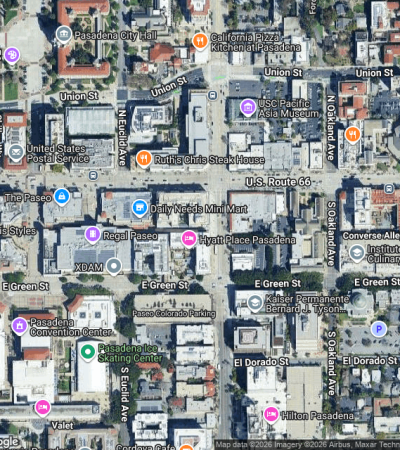
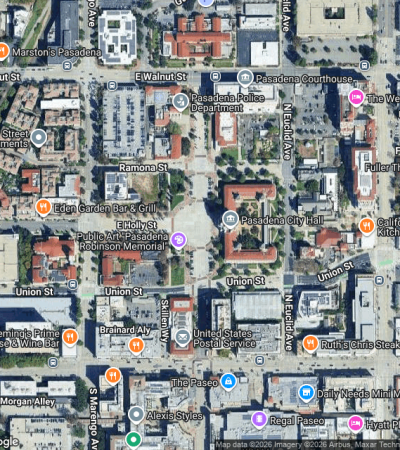
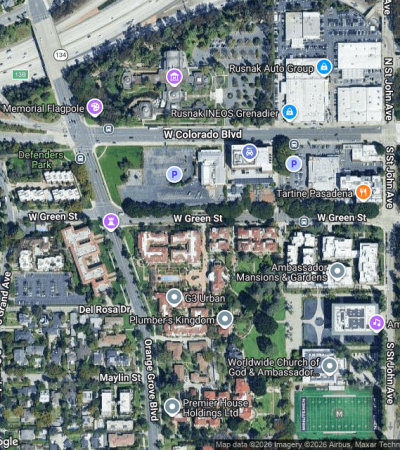
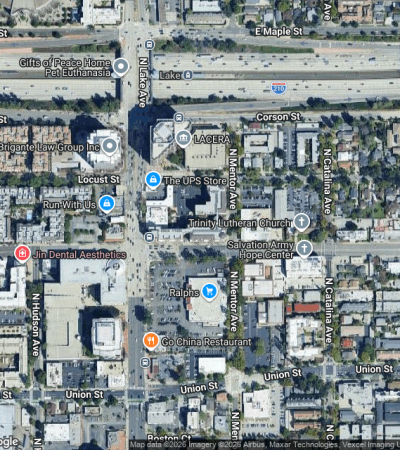
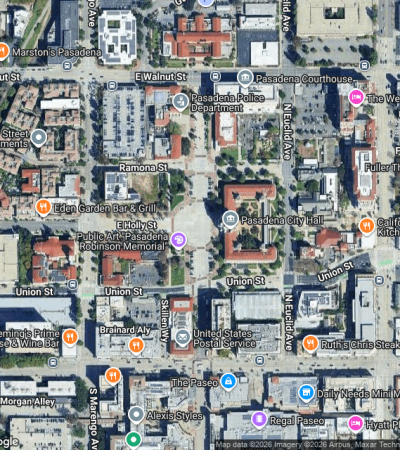
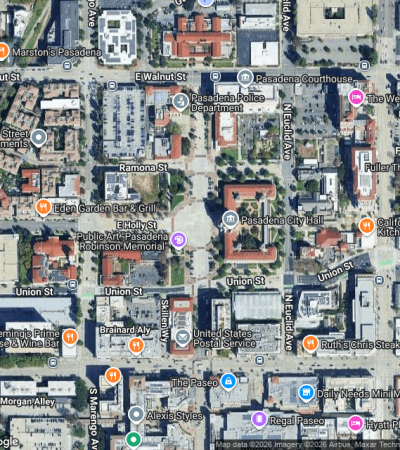
Condos concentrate where Pasadena zoned for density, a narrow band of the city. The heaviest concentration runs through the central corridor: Old Pasadena and the blocks around Colorado Boulevard, the Playhouse District, and the South Lake retail spine near Lake Avenue. A second cluster sits west of the civic center along Orange Grove Boulevard, once called Millionaire’s Row and home to William Wrigley Jr.’s estate, now the Tournament of Roses headquarters. A third and newest cluster is the redeveloped Ambassador campus.
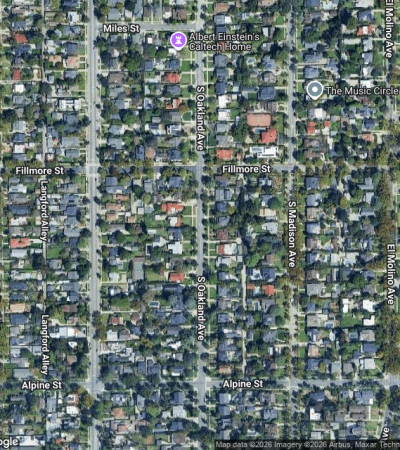
Outside those bands, Pasadena is single-family. Bungalow Heaven, a 125-acre landmark district bounded roughly by North Mentor Avenue, East Orange Grove Boulevard, East Washington Boulevard and North Chester Avenue, holds more than 800 Craftsman houses built between 1900 and 1930. It became a local landmark district in 1989 and joined the National Register of Historic Places on April 10, 2008. You will not find a condo tower there, and that is the point: the historic fabric that makes Pasadena desirable also caps condo supply.
Because supply is constrained and concentrated, a specific building’s availability, not citywide inventory, determines whether you can buy where you want.
Below is the full set of Pasadena condo communities we track, each with its own page. Start with the market-wide view on our homes for sale in Pasadena page, then narrow.
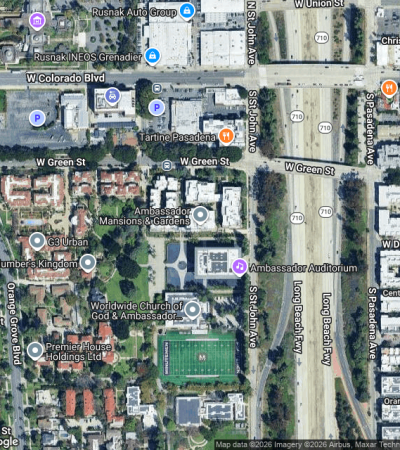
The Ambassador Gardens group. This is the most consequential new-construction story in Pasadena condos. On May 14, 2004 the Worldwide Church of God sold roughly 13 acres of its 31-acre Ambassador College campus to Harvest Rock Church and Maranatha High School, and from 2010 to 2019 the balance of the campus was parceled and sold to developers who removed most remaining structures in favor of apartment and condominium buildings. Four of our pages cover that redevelopment: Ambassador Gardens as the parent community, plus Terraces at Ambassador Gardens, The Bungalows at Ambassador Gardens, and Jamieson Place at Ambassador Gardens. Buyers who want current construction standards, newer building systems, and an HOA whose reserve schedule has not yet faced a major capital event should look here first.
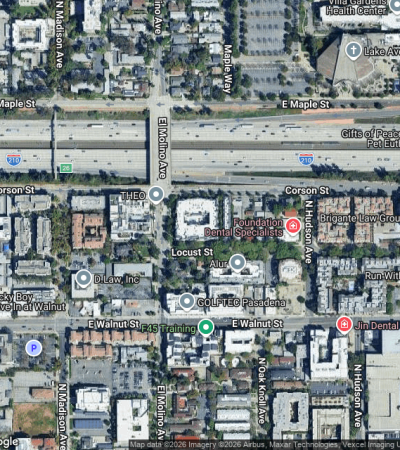
The Lake Avenue and South Lake corridor. Lake Avenue is both a retail spine and an A Line station name, which makes it one of the few places in Pasadena where a condo delivers walkable shopping and rail in the same block. Communities along and near it include 700 Lake, Prado on Lake, and Lake at Walnut. Nearby, The Montana and Rose Tree serve buyers who want the same central access at a different scale.
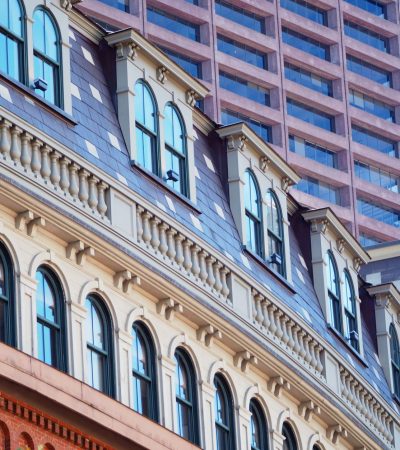
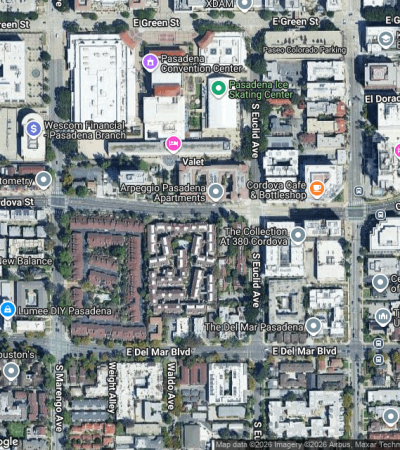
Old Pasadena and the loft conversions. Old Pasadena is the city’s original commercial center, roughly bounded by Interstate 210, Fair Oaks Avenue, Arroyo Parkway, Del Mar Boulevard and State Route 134. It was recognized locally in 1980, listed on the National Register of Historic Places in 1983, then revitalized through more than $400 million in combined public and private investment. That revitalization is why loft product exists here at all. See Cinema Lofts, Ostrich Farm Lofts, and the Boston Centennial Building. Nearby, 388 Cordova and Cordova Park Villas both carry the Cordova Street name.
The Madison Heights and El Molino side. Madison Heights is bordered by California Boulevard to the north, Marengo Avenue to the west, and South Pasadena to the south, with Lake Avenue, Oak Knoll Avenue and El Molino Avenue on its eastern edge. It is served by Allendale Elementary and Blair International Baccalaureate School. Pages in and around this area include Madison Heights, Madison Walk, El Molino Terrace, 178 Euclid, Eight Twenty, and Domaine 39.
Orange Grove and the garden-court communities. The Orange Grove corridor holds several of Pasadena’s low-rise, landscaped condo communities: Orange Grove Village II, Orange Grove Terrace, Garden Grove, The Gardens on Hill, and California Rose Court. These trade on square footage and outdoor space rather than views or amenity packages.
West Pasadena and the Arroyo side. West of the civic center, toward the Arroyo Seco and the Rose Bowl, the stock is quieter and more residential in feel. Relevant pages include West Grove, Waverly House, Pasadena Collection West, Pasadena Collection East, Terra Bella, Hudson Terrace, Franciscan Woods, and Arroyo Woods.
South and east Pasadena. Oak Knoll is the southernmost neighborhood in Pasadena, established in 1905 by A. Kingsley Macomber, Henry E. Huntington and William R. Staats. Its namesake knoll is a 150-foot ridge formed by the Raymond Fault, and the neighborhood contains the Langham Huntington hotel and the Greene and Greene Blacker House. Attached product here is scarce and priced accordingly. To the east, Hastings Ranch sits near the Sierra Madre Villa end of the city, closest to the 210 and to the A Line’s northern Pasadena terminus.
We do not publish a headline price here, and that is deliberate. Condo pricing in Pasadena is building-specific to a degree that a citywide median actively misleads. A 1972 two-bedroom in a garden complex with deferred exterior work and a 2019 two-bedroom on the Ambassador site are not the same asset.
The variables that move price here, in rough order of impact: age and construction type, HOA reserve position and any pending special assessment, parking configuration, walkability to Old Pasadena or a Metro station, and private outdoor space. Post-2025, association insurance cost has become a sixth variable, and in some buildings it is the fastest-moving one.
Ask us for a building-level comparable set rather than a city median. We will show you the last twelve months of closed sales inside the specific association you are considering.
Every Pasadena condo is governed by the Davis-Stirling Common Interest Development Act, California Civil Code section 4000 and following, passed in September 1985 and reorganized through Assembly Bill 805 effective January 1, 2014. It sets the rules for the association’s governing documents, assessments, lien procedures and disclosures to you.
The practical consequence is that you are buying two things: a unit and a share of a corporation. The Declaration of Covenants, Conditions and Restrictions is binding on you to the extent it does not conflict with state or federal law, and it will dictate what you can change, whether you can rent, and what you owe. Read it. Read the reserve study alongside it.
The trade-off, named plainly: low dues are not automatically good. Dues well below the peer set frequently signal underfunded reserves, and in a fifty-year-old building that makes a special assessment a question of timing rather than of whether. We would rather put you into a building with honest dues and a funded reserve than one that looks cheap on the monthly and hands you a five-figure assessment in year three.
Pasadena sits about 10 miles northeast of downtown Los Angeles, and it has more transit options than most of the county. The Metro A Line, formerly the Gold Line, opened its Pasadena segment on July 26, 2003 between Union Station and Sierra Madre Villa station in east Pasadena, and the line now continues south through downtown Los Angeles to Long Beach. Six stations serve the city: Fillmore, Del Mar, Memorial Park, Lake, Allen, and Sierra Madre Villa. At Union Station you transfer to the B and D subway lines, Metrolink, Amtrak, and regional bus service.
By car, the 210 freeway, built in 1970, crosses the city’s northern half. The Arroyo Seco Parkway, State Route 110, opened in 1940 as California’s first freeway and still connects Pasadena directly to downtown Los Angeles. The 134 links west toward Glendale and Burbank.
If rail access is a requirement rather than a preference, say so early. A short walk to Del Mar, Memorial Park or Lake is a durable resale attribute in a way that a two-mile drive to the same station is not.
Most of the city is served by Pasadena Unified School District, which also covers Sierra Madre and Altadena. District enrollment was 14,404 students in the 2023 to 2024 academic year, down from a peak of 23,559 in 2000. The district operates 14 elementary schools, three middle schools, four high schools, and one continuation school.
PUSD runs several distinctive programs. Dual language immersion includes French at Altadena Arts Magnet, Mandarin at Field Elementary, and Spanish at Mary W. Jackson and San Rafael elementary schools. Magnet options include Charles W. Eliot Arts Magnet at the middle level and the Octavia Butler Magnet. Blair is an International Baccalaureate high school serving the Madison Heights area.
Confirm attendance boundaries and program eligibility with the district before you buy on the basis of a specific school. A listing description is not an enrollment guarantee.
This is the risk factor that most affects Pasadena buying decisions right now, and it deserves a direct answer. The Eaton Fire started on January 7, 2025 at approximately 6:18 p.m. and was fully contained on January 31, 2025 after burning 14,021 acres. It destroyed 9,418 structures and damaged 1,071 more, including 4,356 single-family homes and 77 multi-family buildings. Nineteen people died. The U.S. Department of Justice determined that faulty Southern California Edison power lines caused the fire.
The heaviest destruction was in Altadena, immediately north of Pasadena, not in the central corridors where condos sit. But Pasadena was materially affected: Pasadena Unified, Pasadena City College, Caltech and Fuller Theological Seminary all closed, more than 100,000 residents across the region evacuated, and the fire and firefighting response contaminated the water supply of neighborhoods served by Pasadena Water and Power.
For a condo buyer this is mostly an insurance and disclosure question. Association master policies across the San Gabriel Valley have repriced. Ask for the current master policy, the premium history for the last three years, and whether the board has discussed a dues increase or assessment tied to insurance. These are answerable questions, and we will ask them for you.
Two separate rules govern this, and buyers routinely conflate them.
The first is state law. The Costa-Hawkins Rental Housing Act, enacted in 1995, exempts condominiums from municipal rent control because they are separately alienable units. It also exempts single-family dwellings and units with a certificate of occupancy issued after February 1, 1995. Pasadena voters adopted a rent stabilization charter amendment, Measure H, adding Article XVIII to the city charter and creating a Pasadena Rental Housing Board. Costa-Hawkins constrains how far a local ordinance can reach into separately owned condominium units, but application to your unit depends on its specific facts. Get that opinion from a real estate attorney, not from a listing agent and not from this page.
The second is your HOA. Many Pasadena associations cap the percentage of units that may be leased, impose minimum lease terms, or bar short-term rentals outright, and those caps are enforceable under Davis-Stirling regardless of what state law permits. An association rental cap is also a financing issue: high investor concentration can affect a building’s eligibility for certain loan programs. If your plan involves leasing the unit, we check the rental cap before you write, not after.
Age is the defining variable in this market. Pasadena’s condo stock spans roughly five decades of building code, and the older end carries real, knowable issues.
Focus on the building envelope and shared systems, because those generate special assessments. Roof age and remaining life. Plumbing material and whether a repipe has been done or is scheduled. Electrical service capacity, which matters more now that buyers want induction ranges and EV charging. Seismic retrofit status, a live question in any structure with tuck-under parking. Elevator and boiler age in mid-rise buildings.
Adaptive-reuse lofts add their own list: unconventional layouts, mechanical systems retrofitted rather than designed in, and sound transmission that differs sharply from purpose-built residential. Historic designation, where it applies, can constrain exterior alterations. None of that is disqualifying. All of it should be known before you commit, not after.
Pasadena delivers something rare in Los Angeles County: a real downtown you can walk. Old Pasadena spans roughly 21 blocks of shops, restaurants, cafés and bars, built into a National Register historic district rather than a purpose-built retail center. Notable structures include the Green Hotel, which opened in 1888, the Castle Green, the Hotel Carver, and the Dodsworth Building.
The cultural calendar is unusually strong for a city this size. The Tournament of Roses Parade has run since 1890 and is held each January 1, and the Rose Bowl, a National Historic Landmark, hosts the Rose Bowl Game. The Doo Dah Parade started in Old Pasadena in 1978. The Norton Simon Museum, the Pasadena Museum of History and the Armory Center for the Arts are all in the city, and the Huntington Library and Botanical Gardens is adjacent in San Marino.
The Arroyo Seco is the city’s defining natural feature, running from headwaters in the Angeles National Forest greenbelt and forming the setting for the Rose Bowl. For a condo owner without a yard, proximity to it is a real differentiator between west-side and central buildings.
For most buyers under a certain budget, it is the only realistic path to owning in the city. Pasadena’s single-family stock is heavily historic and heavily protected. A condo buys you the location and the institutional access. It does not buy you land, and you should price that difference honestly.
In practice the terms describe form, not ownership. Most attached homes marketed as townhomes in Pasadena are still condominiums in the legal sense, governed by the same Davis-Stirling framework and the same CC&Rs. Read the title documents rather than the marketing copy.
Yes, most notably on the redeveloped Ambassador College campus, which between 2010 and 2019 was parceled and sold to developers who replaced most remaining structures with apartment and condominium buildings. The Ambassador Gardens communities linked on this page cover that stock.
Usually, but the configuration varies. Deeded spaces, assigned spaces and shared permit arrangements are all present in this market, and they are not equivalent for resale. Confirm what conveys with the unit before you write.
About 10 miles northeast. The Metro A Line connects Pasadena to Union Station directly, and the Arroyo Seco Parkway, State Route 110, has linked the two cities since 1940.
It should change what you ask about, not whether you buy. The condo corridors were not the areas destroyed. The relevant follow-through is the association’s master insurance policy, its premium trajectory, and any board discussion of assessments tied to insurance cost.
It varies by association and there is no useful citywide answer. Under Davis-Stirling the association is responsible for what its governing documents assign to it, commonly the exterior, common areas and master insurance. What differs is water, trash, and whether unit-side systems are association or owner responsibility.
Often yes, and you should try. California requires seller disclosure of association documents in a resale transaction, and many sellers will provide budgets, reserve studies and recent minutes on request during the offer stage. We ask for them upfront as a matter of routine.
We work building by building, not neighborhood by neighborhood. In a market where an association’s reserve position can swing your true monthly cost by hundreds of dollars, the useful unit of analysis is the specific HOA, and that is where we spend our diligence time.
A typical engagement runs like this. We define your requirements, including rail access, outdoor space, parking and rental intent, then map those against the buildings that satisfy them. We pull building-level comparable sales rather than citywide medians. Before you write an offer, we request the association’s budget, reserve study, recent minutes and master insurance policy, and we tell you what we find, including when the answer is that you should walk.
Browse the communities linked above, or contact The Knight Group to talk through which Pasadena buildings fit what you are actually trying to do.
The Knight Group is here to help you with all your realty needs. To get started, fill out the form below and one of our experienced agents will contact you as quickly as possible.
Copyright © 2024 The Knight Group.
All rights reserved. License: 02133297
Lucky for you we’re looking out.
Subscribe to this Custom Search to be alerted when new properties hit the market in the area.
Choose the frequency that works for you.