Browse all Orange County real estate.

Browse all Orange County real estate.
No properties found. |
Williams Canyon homes for sale sit on the western slopes of the Santa Ana Mountains in eastern Orange County, between Silverado Canyon to the north and Modjeska Canyon to the south. The community is unincorporated, carries the Silverado 92676 ZIP code, and covers about 0.57 square miles at roughly 1,220 feet of elevation. Most of it is surrounded by the Cleveland National Forest. The 2020 Census counted 93 residents, and inventory turns over slowly.
This is a land-and-acreage market rather than a floor-plan market: large parcels, custom homes, horse property, and land zoned for farm animals, orchards, or a vineyard. What varies most is readiness. Some parcels come with estate plans and setbacks a fire authority has already reviewed; others are raw land where access, water, septic, utilities, and grading are all on the buyer.
Inventory in Williams Canyon is thin and turns over slowly. If you are considering a purchase or sale here, browse the current listings below or contact The Knight Group to talk through what actually trades in this market and what it takes to buy or sell in a canyon.
Williams Canyon is an unincorporated community and census-designated place in Orange County, sitting on the western slopes of the Santa Ana Mountains at roughly 1,220 feet of elevation. The Census Bureau first designated it as a CDP in 2020, and its footprint covers about 0.57 square miles.
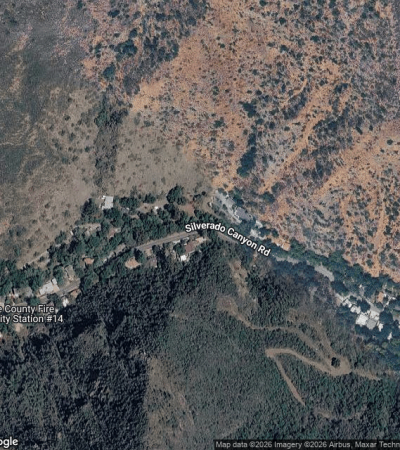
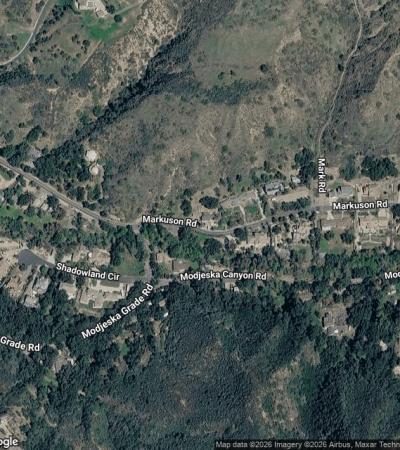
Geographically it is the middle canyon in a row of three. Silverado Canyon runs to the north and carries the longest settlement history of the group. Modjeska Canyon sits to the south. Williams Canyon connects out to the wider road network by way of Santiago Canyon Road, which is the main artery linking these mountain communities to the rest of Orange County.
Because most of the community is surrounded by the Cleveland National Forest, the developable land is limited and the boundaries between private parcels and federal land matter a great deal. That adjacency is part of what buyers pay for, and it is also part of what shapes the risk profile of owning here.
Williams Canyon is a land-and-acreage market, not a floor-plan market. Property here skews toward large parcels, custom homes, and agriculturally usable land rather than uniform subdivisions. Some parcels run to many acres and sit at the end of private roads with only a handful of neighbors sharing access.
The uses these parcels support are the reason people buy. Owners can build a custom home, keep horses, raise farm animals, or plant an orchard or a vineyard on land zoned to allow it. Parcels of this size and character are rarely available in Orange County, which is a large part of why canyon land holds interest even when the county around it is fully built out.
Buyers should understand that a canyon parcel is not a turnkey purchase in the way a suburban home is. Access, water, septic, utilities, grading, and fire-authority setbacks all factor into what a lot can actually become. Some listings come with previously designed estate plans and setbacks that a fire authority has already reviewed, which can shorten the path to building. Others are raw land where the buyer carries the full weight of due diligence. Knowing which is which before you write an offer is the difference between a smooth build and a stalled one.
Williams Canyon is one of the smallest communities in Orange County. As of the 2020 Census it had a population of 93 residents. That number tells you most of what you need to know about daily life here: it is quiet, established, and closely held, with a small resident base rather than a steady flow of new construction and turnover.
The people who own here tend to be there on purpose. Canyon living asks for a tolerance of narrow roads, longer drives to shopping and services, and the realities of maintaining property that borders wild land. In exchange, residents get privacy, dark skies, and a setting that reads more like a rural mountain community than a coastal Orange County suburb, even though it sits inside one of the most populous counties in the country.
Williams Canyon takes its name from Marshall Williams, a bachelor beekeeper who settled in the canyon before 1878. The name first appeared in print in the Anaheim Gazette in October 1878. The Higuera family are recorded as among the first residents in the 1870s, and the canyon’s early economy grew out of agriculture rather than mining.
That agricultural bent is the historical thread that still runs through the area. While neighboring Silverado Canyon built its early identity around mining, Williams Canyon leaned on beekeeping and small-scale ranching, which local history describes as a steadier income for mountain pioneers than mining ever was. Judge Joseph Edward Pleasants, a long-lived early Orange County figure, held roughly 318 acres near the mouth of the canyon and lived in the area for decades.
Understanding this history matters for a buyer because it explains the land pattern you see today. The large, agriculturally oriented parcels are not an accident of zoning alone. They are the descendants of ranch and homestead land that was never subdivided into the tract grid that covers most of the county.
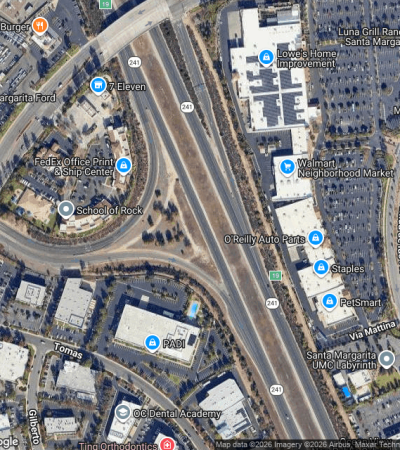
Access runs through Santiago Canyon Road, the two-lane route that connects the Silverado, Williams, and Modjeska canyon communities to the rest of Orange County. From Santiago Canyon Road, drivers reach the SR-241 toll road, which links this part of the county toward central and southern Orange County and onward to the broader freeway network.
Buyers should weigh the commute honestly. This is not a five-minute drive to the freeway. Canyon roads are narrow and winding, and Santiago Canyon Road itself has been the subject of county safety-improvement work. During wildfire events, canyon roads and nearby toll-road segments can close, which is a real consideration for anyone who commutes daily or needs reliable access to services.
The trade-off is the one that defines this entire market. You accept a longer, slower connection to the rest of the county in exchange for the space and quiet that come with a mountain address. For some buyers that is exactly the point. For others it is a dealbreaker, and it is better to know which camp you are in before you fall for a parcel.
The canyon communities have historically fallen within the Orange Unified School District. For over a century, local children attended Silverado Elementary on Silverado Canyon Road, a school whose roots on that site trace back to the early 1900s. The district closed Silverado Elementary in 2010 over the objections of many canyon residents, and children from the area now travel out of the canyon to attend school.
Because school assignment in and around these unincorporated canyon communities can be nuanced, and because the historic neighborhood school no longer operates, families with school-age children should verify current attendance boundaries and school assignments directly with the district before purchasing. Do not assume a canyon address maps to a nearby campus. Confirm it in writing.
Wildfire is the central risk factor of owning in these canyons, and it should be treated as such rather than glossed over. Williams Canyon sits within and against the Cleveland National Forest in the Santa Ana Mountains, a landscape with a long record of brush fires and mandatory evacuations. The Silverado Fire that started in September 2014 is one of several incidents that have burned in and around these canyons, and canyon residents live with recurring fire seasons and evacuation orders.
For a buyer, this has concrete consequences. Properties in high fire hazard areas face higher insurance costs and, in some cases, difficulty obtaining coverage at all. Building and rebuilding come with fire-authority setback and defensible-space requirements. Fire-season road closures can cut off access. A post-fire landscape can also carry a heightened flood and debris-flow risk on burned slopes.
None of this means the canyons are unbuyable. It means the risk has to be priced in and planned for. Before you commit, get clear on insurability, defensible-space obligations, and evacuation logistics. A knowledgeable agent will push you to answer these questions early rather than discover them after closing.
Daily life in Williams Canyon is rural and self-reliant. Services are not around the corner. Grocery runs, restaurants, and errands mean a drive down the canyon and out to the surrounding communities. In exchange, residents get a setting defined by open space, forest frontage, and a small, established neighbor base rather than a dense subdivision.
The lifestyle rewards people who want land to use. Horse keeping, small-scale farming, gardening, and building a private compound are all realistic here in a way they simply are not on a standard Orange County lot. The forest boundary means trails, wildlife, and quiet are part of the everyday backdrop. The same boundary means you are responsible for managing brush, access, and fire preparedness on your own land.
This is a market for buyers who value privacy and space over convenience and walkability. If your priorities are a short commute, nearby amenities, and low-maintenance ownership, the canyons will frustrate you. If your priorities are acreage, quiet, and the ability to shape your own land, few places in Orange County offer what these canyons do.
The investment case for Williams Canyon rests on scarcity. Large, agriculturally zoned parcels in Orange County are rare and are not being created, which supports long-term interest in canyon land. For a buyer who wants to build a custom home or hold acreage with genuine use value, the appeal is real and durable.
The counterweights are just as real. Canyon property is less liquid than suburban housing, meaning it can take longer to sell and the buyer pool is narrower. Wildfire risk, insurance cost, access constraints, and the due-diligence burden of building on canyon land all weigh on the equation. This is not a market for a buyer who needs a fast, clean, low-variance transaction.
The honest summary is that Williams Canyon rewards the right buyer and punishes the wrong one. If you understand the risks, want the land, and plan to hold, it can be an excellent purchase. If you are stretching for it and expecting suburban liquidity and suburban simplicity, it is the wrong market. A good agent’s job is to tell you which of those you are before you commit capital.
Williams Canyon is the middle of three neighboring canyon communities, and buyers who look at one usually end up comparing all three. Silverado Canyon, to the north, is the largest and best known of the group, with the longest settlement history and a mining past that shaped its early identity. Modjeska Canyon, to the south, carries its own history tied to the actress Helena Modjeska and the old Modjeska Mineral Springs resort that operated in the early 1900s.
Williams Canyon differs mainly in scale and character. It is smaller and quieter than Silverado, with fewer residents and a more agricultural, land-oriented past built on beekeeping and ranching rather than mining. For a buyer, that generally translates to larger, more private parcels and even thinner inventory than the neighboring canyons.
The three communities share the same fundamentals: forest adjacency, wildfire exposure, canyon-road access, and a rural lifestyle that trades convenience for space. Which canyon fits you comes down to how much privacy and acreage you want, what you plan to do with the land, and how you weigh the shared risks. We are happy to walk you through all three so you are comparing them on the same terms.
No. Williams Canyon is an unincorporated community and census-designated place in Orange County, not part of an incorporated city. It uses the Silverado 92676 ZIP code and is governed at the county level rather than by a city government.
Williams Canyon covers about 0.57 square miles and recorded a population of 93 in the 2020 Census, making it one of the smallest communities in Orange County. The Census Bureau first designated it as a census-designated place in 2020.
Yes, on appropriately zoned parcels. Much of the land here supports horse keeping, farm animals, and agricultural uses such as orchards and vineyards. You should confirm the specific zoning and permitted uses on any parcel before purchasing, since not every lot carries the same rights.
Yes. The community sits within and against the Cleveland National Forest in the Santa Ana Mountains, an area with a documented history of brush fires and mandatory evacuations. Buyers should factor insurance cost and availability, defensible-space requirements, and evacuation logistics into any purchase decision.
The canyon communities have historically fallen under the Orange Unified School District, and the local Silverado Elementary served the area for more than a century before closing in 2010. Because the neighborhood school no longer operates and boundaries in these unincorporated areas can be nuanced, families should verify current school assignments directly with the district.
Access is by way of Santiago Canyon Road, which connects the Silverado, Williams, and Modjeska canyon communities to the rest of Orange County and to the SR-241 toll road. Canyon roads are narrow and winding, and they can close during wildfire events.
The community is very small, most of the surrounding land is national forest, and the private parcels are large holdings that rarely change hands. That combination keeps the number of homes and lots on the market low and turnover slow.
It can be, for the right buyer. Large parcels, forest frontage, and agricultural uses make it well suited to a custom estate or compound. The offset is that building on canyon land involves access, utilities, septic, grading, and fire-authority requirements that a buyer must plan for carefully before committing.
The Knight Group treats Williams Canyon as what it is: a scarce, specialized canyon market that rewards precision. We do not pretend it trades like a suburban tract. Before you make an offer, we help you pressure-test the things that actually decide whether a canyon purchase works, including insurability and fire exposure, access and road status, zoning and permitted uses, and the real cost and timeline of building on the land.
On the sell side, the challenge is reaching the narrow pool of buyers who genuinely want canyon acreage and can execute on it. We position these properties to the people who value what they offer rather than casting to a broad market that will never appreciate the trade-offs.
If you are weighing a purchase or a sale in Williams Canyon, browse the current listings below or contact The Knight Group directly. We will give you a straight read on the market, the risks, and the path forward, and we will tell you plainly if the canyon is the wrong fit for what you are trying to do.
The Knight Group is here to help you with all your realty needs. To get started, fill out the form below and one of our experienced agents will contact you as quickly as possible.
Copyright © 2024 The Knight Group.
All rights reserved. License: 02133297
Lucky for you we’re looking out.
Subscribe to this Custom Search to be alerted when new properties hit the market in the area.
Choose the frequency that works for you.